
The Problem
Conventional electronics that rely only on moving electric charge are hitting limits in heat, power use, and miniaturization.

Conventional electronics that rely only on moving electric charge are hitting limits in heat, power use, and miniaturization.
Researchers propose designing nitride materials that combine electric and magnetic properties so spin can be controlled with an electric field.
This approach could enable faster, low-power devices that store and process information more efficiently.
Professor James Rondinelli, Postdoctoral scholar Steven Baksa, Research associate Linding Yuan
Computers and other electronic devices rely on a flowing electric charge to store and process information. As computing demands increase, that approach is running up against limits in heat generation, power consumption, and device scaling. One way researchers are addressing these constraints is through spintronics, which uses not only an electron’s charge but also its spin. Controlling spin could enable faster switching, lower energy use, and new ways to integrate memory and logic within a single device.
Recent work from Northwestern Engineering’s James Rondinelli identifies a new class of multiferroic materials that could help make that vision practical.
The study focuses on ternary nitride compounds that combine several properties that are rarely found together, including ferroelectricity, magnetism, and non-relativistic spin splitting. These combined characteristics suggest a pathway to electronic components that are faster, smaller, and more energy efficient than current technologies.
Magnetoelectric and spintronic devices based on such materials could retain information without constant power, switch states rapidly, and generate less heat—advantages that matter for applications ranging from data centers to personal electronics.
The result could be new forms of memory, storage, and other components suited for quantum and high-performance computing.
“Ferroelectricity and magnetism rarely coexist in a single material, and when they do, the cross-coupling between them becomes a design lever,” Rondinelli said. “Our ultimate goal is to use those levers to write and read spin states with voltage pulses to slash the energy cost of a switching event by orders of magnitude compared to conventional transistors.”
Rondinelli is the Walter Dill Scott Professor of Materials Science and Engineering at Northwestern’s McCormick School of Engineering and leads the Materials Theory and Design group. He presented the work in the paper “Ferroelectricity in Antiferromagnetic Wurtzite Nitrides,” published April 24 in the journal Advanced Functional Materials.
Ferroelectric materials have a natural separation of positive and negative charge—like a tiny built-in battery—that can be flipped by applying an electric field. Engineers could control magnetic states using electricity instead of less efficient magnetic fields by linking this behavior with magnetism.
Multiferroic materials bring these properties together in one material, but very few work well at everyday temperatures. In this study, Rondinelli and his team identified a set of nitride materials where both electric and magnetic behaviors can exist at the same time, thanks to carefully choosing and arranging the elements inside them, allowing these properties to remain stable at or near room temperature.
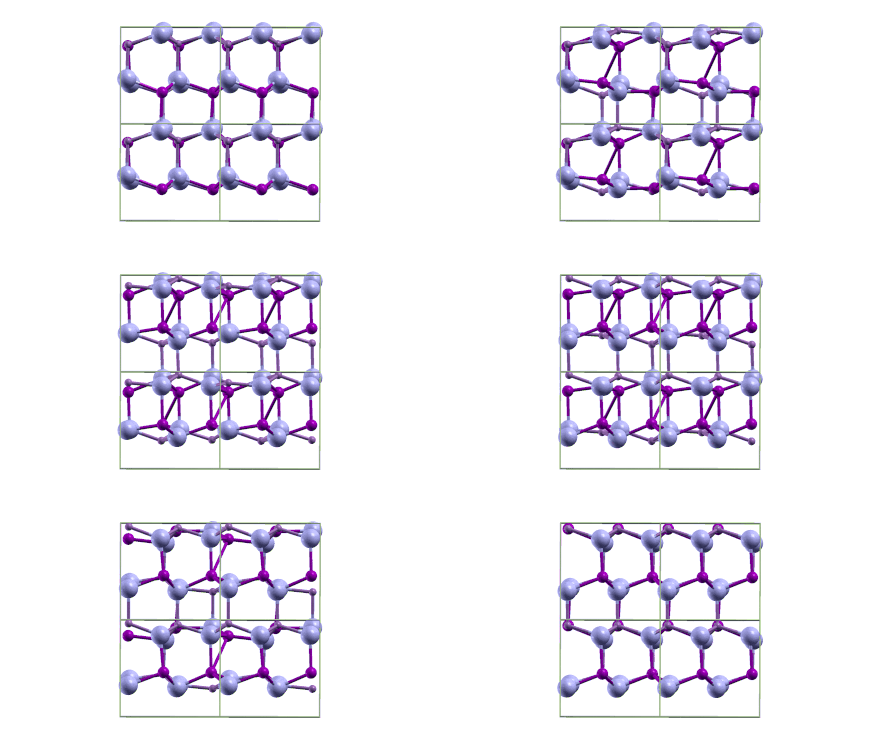
Rondinelli’s team found that some nitride materials made with zinc or magnesium are good at holding and switching electric charge, while those made with manganese show strong, stable magnetic behavior, exhibiting altermagnetic spin splitting, and act like semiconductors. By swapping a small number of zinc or magnesium atoms into the manganese-based materials, they were able to preserve that magnetic behavior while adding electric polarization, combining both properties in a single material.
“Our next step is to partner with growers and device engineers who can put these predictions to the test. If successful, the implications run deep. Nitrides already underpin some of the most critical electronics in consumer and defense applications,” Rondinelli said.
“Bringing magnetoelectric control into that family of materials could mean smarter, more efficient devices without having to reinvent the manufacturing process from the ground up.”