

Mario Harik Stresses Frontline Workers’ Role in Keeping Freight Moving
The CEO of XPO Inc., Harik spoke at the 44th Annual Patterson Lecture
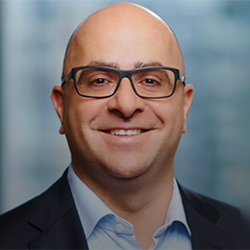
The chairman and CEO of XPO Inc., Mario Harik does not undersell the importance of trucking and transportation.
“There’s something to be said about trucking and transportation: we move the world,” Harik said. “From the things that we wear to the products that we use, ultimately in our country and North America, everything has moved on a truck at some point in time. There’s something very noble about that because ultimately you are keeping the economy moving.”
That process does not happen automatically. It’s the people, Harik said, who fuel the progress.
“You have a great group of people who are making sure that this country keeps on moving and that we are taking care of customers’ freight from Point A to Point B—picked up on time, delivered on time, and get delivered damage-free every single time. It’s a very good business to be in and ultimately, it’s all about the people and it’s all about the customers.”
Harik stressed that message during the 44th Annual William A. Patterson Distinguished Transportation Lecture, held May 13 at the Walter Athletics Center Auditorium. Hosted by the Northwestern University Transportation Center (NUTC), the lecture is named for William A. “Pat” Patterson, a central figure in the US air transport industry for more than four decades who served as president and chairman of United Airlines from 1934 until his retirement in 1966. He was a life trustee of Northwestern University and was instrumental in the establishment and strategic leadership of the NUTC.
Earlier in the day, the NUTC hosted an Industry Technical Seminar that explored AI's role in transportation.
After an introduction by NUTC interim director Bret Johnson, Harik conveyed his message during a fireside chat with Andrew Boyle, co-president of Boyle Transportation.
XPO is a transportation and logistics company that specializes in less-than-truckload shipping, a freight service in which multiple customers’ smaller shipments share space on the same truck. XPO employs around 40,000 people, and Harik sees them not just as workers but sources for ideas to improve the business.
Drivers and dock workers share what’s working well and what isn’t and provide direct feedback. Leadership often uses that input to develop and adjust action plans across the organization.
“Those feedback loops in business are what make your company a better company. You have the collective intelligence of 40,000 people who interact with the customers,” Harik said. “It’s a shame not to tap into that and make sure their voices are heard.”
That attitude plays into another idea Harik emphasized during his remarks: understanding what the company can and cannot control. XPO cannot control the economy. It cannot control market forces, the price of gasoline, or other factors that might impact its business.
“What you can control is providing a great service product to the customer. The customer has a choice. When the economy is soft, there are even more options. You want to give them every single reason why they want to do business with you,” Harik said.
Harik insists that success starts with people, arguing that organizations deliver strong results when they have the right people at every level, from leadership to frontline workers, and that even one underperforming employee can cause an entire function to fall short.
“Ultimately, it’s the drivers who move the freight, and the dock workers who move the freight on the dock. They are the folks who are the closest to the customers,” Harik said. “They are the folks that can see how we’re doing, how the technology is doing, what we are missing in our plan, and what is working well in our plan. They are the folks that matter the most in our company.”