

McCormick Student Entrepreneurs win VentureCat Grand Prize
Trevor Abbott and Quinn McGinley won $100,000 for HaptE
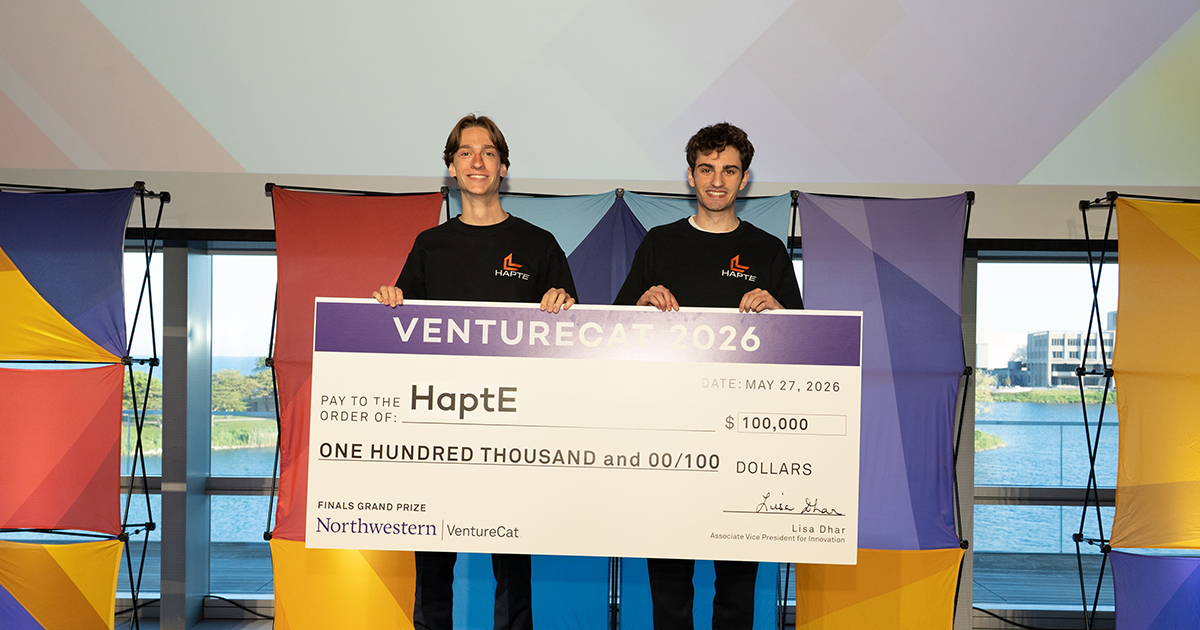
A team of Northwestern Engineering student entrepreneurs won the biggest honor at VentureCat 2026, a University-wide competition and collaborative program at Northwestern.
Trevor Abbott, a fourth-year mechanical engineering student, and Quinn McGinley, a second-year mechanical engineering student, took home the Finals Grand Prize for HaptE, a computer vision system that reduces execution errors and optimizes the warehouse floor in real time. The duo received $100,000 at the VentureCat Public Showcase, held Wednesday night at the Kellogg Global Hub.
“This means a lot,” said Abbott, who was a member of the 2025 Morehead Family Innovator Fellowship program. “HaptE has been around [Northwestern's student startup incubator] The Garage for three years now. We've gone through a lot of iterations, and it took us a while to get here, but every single year we came to VentureCat thinking, ‘Next year, we're gonna do it,’ and we finally did. It feels really good.”
Victoria Israel, a fourth-year student pursuing both bachelor's and master's degrees in mechanical engineering, was one of the original co-founders of HaptE before leaving the company earlier this year to start her career at a later-stage startup
Abbott, founder and CEO of HaptE, and McGinley, the head of product engineering, were far from the only McCormick School of Engineering students honored.
Third-year students Rishi Garg (materials science and engineering) and Viet Tong (biomedical engineering) were members of the team that took second overall and first place in the competition’s Life Sciences and Medical Innovation Track for HydroFlo, a smart catheter technology to monitor shunt flow and detect shunt failure in hydrocephalus. The group earned $50,000.
McCormick students also finished atop the Social Impact Track, as first-year students Rayden Yap (manufacturing and design engineering), Marco Hartono (industrial engineering and management sciences), and Nicolas Angel-Ordonez (industrial engineering and management sciences) contributed to Symbia, which grows carbon-neutral leather out of recycled Kombucha and bacterial culture.
Meanwhile, Tiffany Sorto, a master’s student in mechanical engineering, was on the team behind LumaLift, a consumer wearable bodysuit aimed to help alleviate lumbopelvic pain in pregnant women by lifting and compressing the belly, that finished second in the Life Sciences and Medical Innovation Track. Master of Science in Artificial Intelligence student Eden Growney is on the team that created Xpnse AI, a financial coordination layer for the millions of organizations running on volunteer treasurers and spreadsheets.
“What's clear about this year's VentureCat cohort is that they're building with real intention,” said Mike Raab, executive director of The Garage. “They've embraced AI as a fundamental part of how they work. Not as a shortcut, but as a tool for solving bigger problems faster. The result is a group of founders generating more revenue at this stage than we've ever seen. The bar has been raised this year.”
VentureCat is supported by the Donald Pritzker Entrepreneurship Law Center, The Farley Center for Entrepreneurship and Innovation, the Kellogg School of Management, and The Garage. This year, the event handed out more than $175,000 in non-dilutive funds.